

Chapter 1 freeNo account needed.
Opens “I propose to treat of Poetry in itself and of its va...” in the player · no sign-up needed
Written around 335 BCE, the work provides a foundational analysis of poetry and drama, examining how different poetic forms — tragedy, comedy, epic poetry, and lyric verse — function through imitation.
Inside the book
- Free nowno account · 1 chapter
- 1I propose to treat of Poetry in itself and of its va...3 min
- Premium25 chapters · every book, 7 days free
- 2Since the objects of imitation are men in action, an...1 min
- 3There is still a third difference—the manner in whic...2 min
- 4Poetry in general seems to have sprung from two caus...4 min
- 5Comedy is, as we have said, an imitation of characte...2 min
- 6Of the poetry which imitates in hexameter verse, and...6 min
- 7These principles being established, let us now discu...2 min
- 8Unity of plot does not, as some persons think, consi...1 min
- 9It is, moreover, evident from what has been said, th...3 min
- 10Plots are either Simple or Complex, for the actions...1 min
- 11Reversal of the Situation is a change by which the a...2 min
- 12[The parts of Tragedy which must be treated as eleme...1 min
- 13As the sequel to what has already been said, we must...3 min
- 14Fear and pity may be aroused by spectacular means; b...4 min
- 15In respect of Character there are four things to be...3 min
- 16What Recognition is has been already explained3 min
- 17In constructing the plot and working it out with the...3 min
- 18Every tragedy falls into two parts,—Complication and...3 min
- 19It remains to speak of Diction and Thought, the othe...2 min
- 20[Language in general includes the following parts:—L...3 min
- 21Words are of two kinds, simple and double5 min
- 22The perfection of style is to be clear without being...7 min
- 23As to that poetic imitation which is narrative in fo...2 min
- 24Again, Epic poetry must have as many kinds as Traged...5 min
- 25With respect to critical difficulties and their solu...8 min
- 26The question may be raised whether the Epic or Tragi...4 min
The opening
I propose to treat of Poetry in itself and of its va...
I propose to treat of Poetry in itself and of its various kinds, noting the essential quality of each; to inquire into the structure of the plot as requisite to a good poem; into the number and nature of the parts of which a poem is composed; and similarly into whatever else falls within the same inquiry. Following, then, the order of nature, let us begin with the principles which come first.
Epic poetry and Tragedy, Comedy also and Dithyrambic: poetry, and the music of the flute and of the lyre in most of their forms, are all in their general conception modes of imitation. They differ, however, from one: another in three respects,—the medium, the objects, the manner or mode of imitation, being in each case distinct.
For as there are persons who, by conscious art or mere habit, imitate and represent various objects through the medium of colour and form, or again by the voice; so in the arts above mentioned, taken as a whole, the imitation is produced by rhythm, language, or 'harmony,' either singly or combined.
Thus in the music of the flute and of the lyre, 'harmony' and rhythm alone are employed; also in other arts, such as that of the shepherd's pipe, which are essentially similar to these. In dancing, rhythm alone is used without 'harmony'; for even dancing imitates character, emotion, and action, by rhythmical movement.
There is another art which imitates by means of language alone, and that either in prose or verse—which, verse, again, may either combine different metres or consist of but one kind—but this has hitherto been without a name. For there is no common term we could apply to the mimes of Sophron and Xenarchus and the Socratic dialogues on the one hand; and, on the other, to poetic imitations in iambic, elegiac, or any similar metre. People do, indeed, add the word 'maker' or 'poet' to the name of the metre, and speak of elegiac poets, or epic (that is, hexameter) poets, as if it were not the imitation that makes the poet, but the verse that entitles them all indiscriminately to the name. Even when a treatise on medicine or natural science is brought out in verse, the name of poet is by custom given to the author; and yet Homer and Empedocles have nothing in common but the metre, so that it would be right to call the one poet, the other physicist rather than poet. On the same principle, even if a writer in his poetic imitation were to combine all metres, as Chaeremon did in his Centaur, which is a medley composed of metres of all kinds, we should bring him too under the general term poet. So much then for these distinctions.
There are, again, some arts which employ all the means above mentioned, namely, rhythm, tune, and metre. Such are Dithyrambic and Nomic poetry, and also Tragedy and Comedy; but between them the difference is, that in the first two cases these means are all employed in combination, in the latter, now one means is employed, now another.
Such, then, are the differences of the arts with respect to the medium of imitation.
About the author
Aristotle
384 BC Stageira – 322 BC Chalcis · Greek philosopher
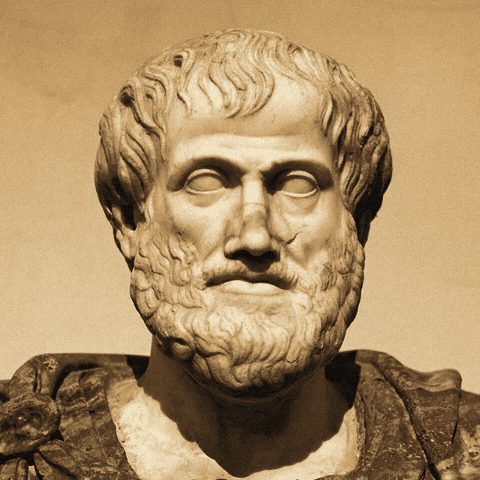
Aristotle was an ancient Greek philosopher and polymath. His writings span the natural sciences, philosophy, linguistics, economics, politics, psychology, and the arts.
More by Aristotle
Keep going with Aristotle


If you like The Poetics of Aristotle
More like this


Start with “I propose to treat of Poetry in itself and of its va...”
First chapter free right now — no account. Your place follows you to iPhone and Android.