

Chapter 1 freeNo account needed.
Opens “The Shade of Cardinal Richelieu” in the player · no sign-up needed
The story reunites the aging musketeers as they navigate the political turmoil of the French Fronde and the English Civil War, where they find themselves on opposing sides while confronting enemies from their past.
Inside the book
- Free nowno account · 1 chapter
- 1The Shade of Cardinal Richelieu19 min
- Premium89 chapters · every book, 7 days free
- 2A Nightly Patrol17 min
- 3Dead Animosities28 min
- 4Anne of Austria at the Age of Forty-six18 min
- 5The Gascon and the Italian10 min
- 6D’Artagnan in his Fortieth Year27 min
- 7Touches upon the Strange Effects a Half-pistole may have12 min
- 8D’Artagnan, Going to a Distance to discover Aramis14 min
- 9The Abbé D’Herblay34 min
- 10Monsieur Porthos du Vallon de Bracieux de Pierrefonds11 min
- 11Wealth does not necessarily produce Happiness16 min
- 12Porthos was Discontented with his Condition10 min
- 13Two Angelic Faces14 min
- 14The Castle of Bragelonne13 min
- 15Athos as a Diplomatist18 min
- 16The Duc de Beaufort10 min
- 17Duc de Beaufort amused his Leisure Hours in the Donjon of Vincennes15 min
- 18Grimaud begins his Functions19 min
- 19Pâtés made by the Successor of Father Marteau are described16 min
- 20One of Marie Michon’s Adventures23 min
- 21The Abbé Scarron21 min
- 22Saint Denis14 min
- 23One of the Forty Methods of Escape of the Duc de Beaufort20 min
- 24The timely Arrival of D’Artagnan in Paris15 min
- 25An Adventure on the High Road12 min
- 26The Rencontre16 min
- 27The four old Friends prepare to meet again16 min
- 28The Place Royale11 min
- 29The Ferry across the Oise18 min
- 30Skirmishing12 min
- 31The Monk19 min
- 32The Absolution11 min
- 33Grimaud Speaks10 min
- 34On the Eve of Battle21 min
- 35A Dinner in the Old Style14 min
- 36A Letter from Charles the First10 min
- 37Cromwell’s Letter14 min
- 38Henrietta Maria and Mazarin11 min
- 39How, sometimes, the Unhappy mistake Chance for Providence14 min
- 40Uncle and Nephew8 min
- 41Paternal Affection16 min
- 42Another Queen in Want of Help22 min
- 43In which it is proved that first Impulses are oftentimes the best13 min
- 44Te Deum for the Victory of Lens31 min
- 45The Beggar of St. Eustache20 min
- 46The Tower of St. Jacques de la Boucherie11 min
- 47The Riot15 min
- 48The Riot becomes a Revolution24 min
- 49Misfortune refreshes the Memory13 min
- 50The Interview12 min
- 51The Flight21 min
- 52The Carriage of Monsieur le Coadjuteur26 min
- 53How D’Artagnan and Porthos earned by selling Straw16 min
- 54In which we hear Tidings of Aramis20 min
- 55The Scotchman16 min
- 56The Avenger17 min
- 57Oliver Cromwell9 min
- 58Jesus Seigneur26 min
- 59Noble Natures never lose Courage, nor good Stomachs their Appetites16 min
- 60Respect to Fallen Majesty14 min
- 61D’Artagnan hits on a Plan30 min
- 62London11 min
- 63The Trial16 min
- 64Whitehall16 min
- 65The Workmen12 min
- 66Remember!10 min
- 67The Man in the Mask15 min
- 68Cromwell’s House11 min
- 69Conversational13 min
- 70The Skiff “Lightning.”18 min
- 71Port Wine15 min
- 72End of the Port Wine Mystery8 min
- 73Fatality13 min
- 74How Mousqueton had a Narrow Escape of being eaten13 min
- 75The Return12 min
- 76The Ambassadors14 min
- 77The three Lieutenants of the Generalissimo20 min
- 78The Battle of Charenton14 min
- 79The Road to Picardy13 min
- 80The Gratitude of Anne of Austria9 min
- 81Cardinal Mazarin as King9 min
- 82Precautions10 min
- 83Strength and Sagacity17 min
- 84Strength and Sagacity—Continued17 min
- 85The Oubliettes of Cardinal Mazarin7 min
- 86Conferences11 min
- 87Chapter 8717 min
- 88Shows how with Threat and Pen more is effected than by the Sword26 min
- 89Difficult for Kings to return to the Capitals of their Kingdoms21 min
- 90Conclusion4 min
The opening
The Shade of Cardinal Richelieu
In a splendid chamber of the Palais Royal, formerly styled the Palais Cardinal, a man was sitting in deep reverie, his head supported on his hands, leaning over a gilt and inlaid table which was covered with letters and papers. Behind this figure glowed a vast fireplace alive with leaping flames; great logs of oak blazed and crackled on the polished brass andirons whose flicker shone upon the superb habiliments of the lonely tenant of the room, which was illumined grandly by twin candelabra rich with wax-lights.
Any one who happened at that moment to contemplate that red simar—the gorgeous robe of office—and the rich lace, or who gazed on that pale brow, bent in anxious meditation, might, in the solitude of that apartment, combined with the silence of the ante-chambers and the measured paces of the guards upon the landing-place, have fancied that the shade of Cardinal Richelieu lingered still in his accustomed haunt.
It was, alas! the ghost of former greatness. France enfeebled, the authority of her sovereign contemned, her nobles returning to their former turbulence and insolence, her enemies within her frontiers—all proved the great Richelieu no longer in existence.
In truth, that the red simar which occupied the wonted place was his no longer, was still more strikingly obvious from the isolation which seemed, as we have observed, more appropriate to a phantom than a living creature—from the corridors deserted by courtiers, and courts crowded with guards—from that spirit of bitter ridicule, which, arising from the streets below, penetrated through the very casements of the room, which resounded with the murmurs of a whole city leagued against the minister; as well as from the distant and incessant sounds of guns firing—let off, happily, without other end or aim, except to show to the guards, the Swiss troops and the military who surrounded the Palais Royal, that the people were possessed of arms.
The shade of Richelieu was Mazarin. Now Mazarin was alone and defenceless, as he well knew.
"Foreigner!" he ejaculated, "Italian! that is their mean yet mighty byword of reproach—the watchword with which they assassinated, hanged, and made away with Concini; and if I gave them their way they would assassinate, hang, and make away with me in the same manner, although they have nothing to complain of except a tax or two now and then. Idiots! ignorant of their real enemies, they do not perceive that it is not the Italian who speaks French badly, but those who can say fine things to them in the purest Parisian accent, who are their real foes.
"Yes, yes," Mazarin continued, whilst his wonted smile, full of subtlety, lent a strange expression to his pale lips; "yes, these noises prove to me, indeed, that the destiny of favorites is precarious; but ye shall know I am no ordinary favorite. No! The Earl of Essex, 'tis true, wore a splendid ring, set with diamonds, given him by his royal mistress, whilst I—I have nothing but a simple circlet of gold, with a cipher on it and a date; but that ring has been blessed in the chapel of the Palais Royal,* so they will never ruin me, as they long to do, and whilst they shout, 'Down with Mazarin!' I, unknown, and unperceived by them, incite them to cry out, 'Long live the Duke de Beaufort' one day; another, 'Long live the Prince de Condé;' and again, 'Long live the parliament!'" And at this word the smile on the cardinal's lips assumed an expression of hatred, of which his mild countenance seemed incapable. "The parliament! We shall soon see how to dispose," he continued, "of the parliament! Both Orléans and Montargis are ours. It will be a work of time, but those who have begun by crying out: Down with Mazarin! will finish by shouting out, Down with all the people I have mentioned, each in his turn.
* It is said that Mazarin, who, though a cardinal, had not taken such vows as to prevent it, was secretly married to Anne of Austria.—La Porte's Memoirs.
"Richelieu, whom they hated during his lifetime and whom they now praise after his death, was even less popular than I am. Often he was driven away, oftener still had he a dread of being sent away. The queen will never banish me, and even were I obliged to yield to the populace she would yield with me; if I fly, she will fly; and then we shall see how the rebels will get on without either king or queen.
"Oh, were I not a foreigner! were I but a Frenchman! were I but of gentle birth!"
The position of the cardinal was indeed critical, and recent events had added to his difficulties. Discontent had long pervaded the lower ranks of society in France. Crushed and impoverished by taxation—imposed by Mazarin, whose avarice impelled him to grind them down to the very dust—the people, as the Advocate-General Talon described it, had nothing left to them except their souls; and as those could not be sold by auction, they began to murmur. Patience had in vain been recommended to them by reports of brilliant victories gained by France; laurels, however, were not meat and drink, and the people had for some time been in a state of discontent.
Had this been all, it might not, perhaps, have greatly signified; for when the lower classes alone complained, the court of France, separated as it was from the poor by the intervening classes of the gentry and the bourgeoisie, seldom listened to their voice; but unluckily, Mazarin had had the imprudence to attack the magistrates and had sold no less than twelve appointments in the Court of Requests, at a high price; and as the officers of that court paid very dearly for their places, and as the addition of twelve new colleagues would necessarily lower the value of each place, the old functionaries formed a union amongst themselves, and, enraged, swore on the Bible not to allow of this addition to their number, but to resist all the persecutions which might ensue; and should any one of them chance to forfeit his post by this resistance, to combine to indemnify him for his loss.
Now the following occurrences had taken place between the two contending parties.
On the seventh of January between seven and eight hundred tradesmen had assembled in Paris to discuss a new tax which was to be levied on house property. They deputed ten of their number to wait upon the Duke of Orléans, who, according to his custom, affected popularity. The duke received them and they informed him that they were resolved not to pay this tax, even if they were obliged to defend themselves against its collectors by force of arms. They were listened to with great politeness by the duke, who held out hopes of easier measures, promised to speak in their behalf to the queen, and dismissed them with the ordinary expression of royalty, "We will see what we can do."
Two days afterward these same magistrates appeared before the cardinal and their spokesman addressed Mazarin with so much fearlessness and determination that the minister was astounded and sent the deputation away with the same answer as it had received from the Duke of Orléans—that he would see what could be done; and in accordance with that intention a council of state was assembled and the superintendent of finance was summoned.
This man, named Emery, was the object of popular detestation, in the first place because he was superintendent of finance, and every superintendent of finance deserved to be hated; in the second place, because he rather deserved the odium which he had incurred.
He was the son of a banker at Lyons named Particelli, who, after becoming a bankrupt, chose to change his name to Emery; and Cardinal Richelieu having discovered in him great financial aptitude, had introduced him with a strong recommendation to Louis XIII. under his assumed name, in order that he might be appointed to the post he subsequently held.
"You surprise me!" exclaimed the monarch. "I am rejoiced to hear you speak of Monsieur d'Emery as calculated for a post which requires a man of probity. I was really afraid that you were going to force that villain Particelli upon me."
"Sire," replied Richelieu, "rest assured that Particelli, the man to whom your majesty refers, has been hanged."
"Ah; so much the better!" exclaimed the king. "It is not for nothing that I am styled Louis the Just," and he signed Emery's appointment.
This was the same Emery who became eventually superintendent of finance.
He was sent for by the ministers and he came before them pale and trembling, declaring that his son had very nearly been assassinated the day before, near the palace. The mob had insulted him on account of the ostentatious luxury of his wife, whose house was hung with red velvet edged with gold fringe. This lady was the daughter of Nicholas de Camus, who arrived in Paris with twenty francs in his pocket, became secretary of state, and accumulated wealth enough to divide nine millions of francs among his children and to keep an income of forty thousand for himself.
The fact was that Emery's son had run a great chance of being suffocated, one of the rioters having proposed to squeeze him until he gave up all the gold he had swallowed. Nothing, therefore, was settled that day, as Emery's head was not steady enough for business after such an occurrence.
On the next day Mathieu Molé, the chief president, whose courage at this crisis, says the Cardinal de Retz, was equal to that of the Duc de Beaufort and the Prince de Condé—in other words, of the two men who were considered the bravest in France—had been attacked in his turn. The people threatened to hold him responsible for the evils that hung over them. But the chief president had replied with his habitual coolness, without betraying either disturbance or surprise, that should the agitators refuse obedience to the king's wishes he would have gallows erected in the public squares and proceed at once to hang the most active among them. To which the others had responded that they would be glad to see the gallows erected; they would serve for the hanging of those detestable judges who purchased favor at court at the price of the people's misery.
Nor was this all. On the eleventh the queen in going to mass at Notre Dame, as she always did on Saturdays, was followed by more than two hundred women demanding justice. These poor creatures had no bad intentions. They wished only to be allowed to fall on their knees before their sovereign, and that they might move her to compassion; but they were prevented by the royal guard and the queen proceeded on her way, haughtily disdainful of their entreaties.
At length parliament was convoked; the authority of the king was to be maintained.
One day—it was the morning of the day my story begins—the king, Louis XIV., then ten years of age, went in state, under pretext of returning thanks for his recovery from the small-pox, to Notre Dame. He took the opportunity of calling out his guard, the Swiss troops and the musketeers, and he had planted them round the Palais Royal, on the quays, and on the Pont Neuf. After mass the young monarch drove to the Parliament House, where, upon the throne, he hastily confirmed not only such edicts as he had already passed, but issued new ones, each one, according to Cardinal de Retz, more ruinous than the others—a proceeding which drew forth a strong remonstrance from the chief president, Molé—whilst President Blancmesnil and Councillor Broussel raised their voices in indignation against fresh taxes.
The king returned amidst the silence of a vast multitude to the Palais Royal. All minds were uneasy, most were foreboding, many of the people used threatening language.
At first, indeed, they were doubtful whether the king's visit to the parliament had been in order to lighten or increase their burdens; but scarcely was it known that the taxes were to be still further increased, when cries of "Down with Mazarin!" "Long live Broussel!" "Long live Blancmesnil!" resounded through the city. For the people had learned that Broussel and Blancmesnil had made speeches in their behalf, and, although the eloquence of these deputies had been without avail, it had none the less won for them the people's good-will. All attempts to disperse the groups collected in the streets, or silence their exclamations, were in vain. Orders had just been given to the royal guards and the Swiss guards, not only to stand firm, but to send out patrols to the streets of Saint Denis and Saint Martin, where the people thronged and where they were the most vociferous, when the mayor of Paris was announced at the Palais Royal.
He was shown in directly; he came to say that if these offensive precautions were not discontinued, in two hours Paris would be under arms.
Deliberations were being held when a lieutenant in the guards, named Comminges, made his appearance, with his clothes all torn, his face streaming with blood. The queen on seeing him uttered a cry of surprise and asked him what was going on.
As the mayor had foreseen, the sight of the guards had exasperated the mob. The tocsin was sounded. Comminges had arrested one of the ringleaders and had ordered him to be hanged near the cross of Du Trahoir; but in attempting to execute this command the soldiery were attacked in the market-place with stones and halberds; the delinquent had escaped to the Rue des Lombards and rushed into a house. They broke open the doors and searched the dwelling, but in vain. Comminges, wounded by a stone which had struck him on the forehead, had left a picket in the street and returned to the Palais Royal, followed by a menacing crowd, to tell his story.
This account confirmed that of the mayor. The authorities were not in a condition to cope with serious revolt. Mazarin endeavored to circulate among the people a report that troops had only been stationed on the quays and on the Pont Neuf, on account of the ceremonial of the day, and that they would soon withdraw. In fact, about four o'clock they were all concentrated about the Palais Royal, the courts and ground floors of which were filled with musketeers and Swiss guards, and there awaited the outcome of all this disturbance.
Such was the state of affairs at the very moment we introduced our readers to the study of Cardinal Mazarin—once that of Cardinal Richelieu. We have seen in what state of mind he listened to the murmurs from below, which even reached him in his seclusion, and to the guns, the firing of which resounded through that room. All at once he raised his head; his brow slightly contracted like that of a man who has formed a resolution; he fixed his eyes upon an enormous clock that was about to strike ten, and taking up a whistle of silver gilt that stood upon the table near him, he shrilled it twice.
A door hidden in the tapestry opened noiselessly and a man in black silently advanced and stood behind the chair on which Mazarin sat.
"Bernouin," said the cardinal, not turning round, for having whistled, he knew that it was his valet-de-chambre who was behind him; "what musketeers are now within the palace?"
"The Black Musketeers, my lord."
"What company?"
"Tréville's company."
"Is there any officer belonging to this company in the ante-chamber?"
"Lieutenant d'Artagnan."
"A man on whom we can depend, I hope."
"Yes, my lord."
"Give me a uniform of one of these musketeers and help me to put it on."
The valet went out as silently as he had entered and appeared in a few minutes bringing the dress demanded.
The cardinal, in deep thought and in silence, began to take off the robes of state he had assumed in order to be present at the sitting of parliament, and to attire himself in the military coat, which he wore with a certain degree of easy grace, owing to his former campaigns in Italy. When he was completely dressed he said:
"Send hither Monsieur d'Artagnan."
The valet went out of the room, this time by the centre door, but still as silently as before; one might have fancied him an apparition.
When he was left alone the cardinal looked at himself in the glass with a feeling of self-satisfaction. Still young—for he was scarcely forty-six years of age—he possessed great elegance of form and was above the middle height; his complexion was brilliant and beautiful; his glance full of expression; his nose, though large, was well proportioned; his forehead broad and majestic; his hair, of a chestnut color, was curled slightly; his beard, which was darker than his hair, was turned carefully with a curling iron, a practice that greatly improved it. After a short time the cardinal arranged his shoulder belt, then looked with great complacency at his hands, which were most elegant and of which he took the greatest care; and throwing on one side the large kid gloves tried on at first, as belonging to the uniform, he put on others of silk only. At this instant the door opened.
"Monsieur d'Artagnan," said the valet-de-chambre.
An officer, as he spoke, entered the apartment. He was a man between thirty-nine and forty years of age, of medium height but a very well proportioned figure; with an intellectual and animated physiognomy; his beard black, and his hair turning gray, as often happens when people have found life either too gay or too sad, more especially when they happen to be of swart complexion.
D'Artagnan advanced a few steps into the apartment.
How perfectly he remembered his former entrance into that very room! Seeing, however, no one there except a musketeer of his own troop, he fixed his eyes upon the supposed soldier, in whose dress, nevertheless, he recognized at the first glance the cardinal.
The lieutenant remained standing in a dignified but respectful posture, such as became a man of good birth, who had in the course of his life been frequently in the society of the highest nobles.
The cardinal looked at him with a cunning rather than serious glance, yet he examined his countenance with attention and after a momentary silence said:
"You are Monsieur d'Artagnan?"
"I am that individual," replied the officer.
Mazarin gazed once more at a countenance full of intelligence, the play of which had been, nevertheless, subdued by age and experience; and D'Artagnan received the penetrating glance like one who had formerly sustained many a searching look, very different, indeed, from those which were inquiringly directed on him at that instant.
"Sir," resumed the cardinal, "you are to come with me, or rather, I am to go with you."
"I am at your command, my lord," returned D'Artagnan.
"I wish to visit in person the outposts which surround the Palais Royal; do you suppose that there is any danger in so doing?"
"Danger, my lord!" exclaimed D'Artagnan with a look of astonishment, "what danger?"
"I am told that there is a general insurrection."
"The uniform of the king's musketeers carries a certain respect with it, and even if that were not the case I would engage with four of my men to put to flight a hundred of these clowns."
"Did you witness the injury sustained by Comminges?"
"Monsieur de Comminges is in the guards and not in the musketeers——"
"Which means, I suppose, that the musketeers are better soldiers than the guards." The cardinal smiled as he spoke.
"Every one likes his own uniform best, my lord."
"Myself excepted," and again Mazarin smiled; "for you perceive that I have left off mine and put on yours."
"Lord bless us! this is modesty indeed!" cried D'Artagnan. "Had I such a uniform as your eminence possesses, I protest I should be mightily content, and I would take an oath never to wear any other costume——"
"Yes, but for to-night's adventure I don't suppose my dress would have been a very safe one. Give me my felt hat, Bernouin."
The valet instantly brought to his master a regimental hat with a wide brim. The cardinal put it on in military style.
"Your horses are ready saddled in their stables, are they not?" he said, turning to D'Artagnan.
"Yes, my lord."
"Well, let us set out."
"How many men does your eminence wish to escort you?"
"You say that with four men you will undertake to disperse a hundred low fellows; as it may happen that we shall have to encounter two hundred, take eight——"
"As many as my lord wishes."
"I will follow you. This way—light us downstairs Bernouin."
The valet held a wax-light; the cardinal took a key from his bureau and opening the door of a secret stair descended into the court of the Palais Royal.
About the author
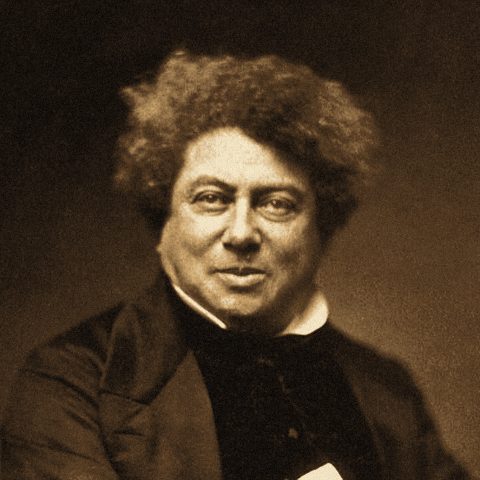
Alexandre Dumas
1802 Villers-Cotterêts – 1870 Puys · French writer and dramatist
Alexandre Dumas, also known as Alexandre Dumas père, was a French novelist and playwright.
- 1802Born, Villers-Cotterêts
- 1844The Count of Monte Cristo
- 1844The Three Musketeers
- 1845Twenty Years After
- 1847The Man in the Iron Mask
- 1848Camille
- 1870Died, Puys
More by Alexandre Dumas
Keep going with Dumas


If you like Twenty Years After
More like this


Start with “The Shade of Cardinal Richelieu”
First chapter free right now — no account. Your place follows you to iPhone and Android.