

3 chapters freeNo account needed.
Opens “Book 1, Chapter 2: The First Societies” in the player · no sign-up needed
The book theorizes that only the general will of the people has the right to legislate, rejecting the notion of divine monarchical power; Rousseau argues that people can only be truly free when they obey laws they collectively establish themselves.
Inside the book
- Free nowno account · 3 chapters
- —Part 1 of 246 min
- —Part 2 of 250 min
- 3Book 1, Chapter 2: The First Societies4 min
- Premium51 chapters · every book, 7 days free
- 4Book 1, Chapter 3: The Right of the Strongest2 min
- 5Chapter 59 min
- 6Chapter 62 min
- 7Book 1, Chapter 6: The Social Compact5 min
- 8Book 1, Chapter 7: The Sovereign4 min
- 9Book 1, Chapter 8: The Civil State2 min
- 10Book 1, Chapter 9: Real Property5 min
- 11Book 2, Chapter 1: That Sovereignty Is Inalienable2 min
- 12Book 2, Chapter 2: That Sovereignty Is Indivisible4 min
- 13Book 2, Chapter 3: Whether the General Will Is Fallible3 min
- 14Book 2, Chapter 4: The Limits of the Sovereign Power7 min
- 15Book 2, Chapter 5: The Right of Life and Death4 min
- 16Chapter 166 min
- 17Book 2, Chapter 7: The Legislator8 min
- 18Book 2, Chapter 8: The People3 min
- 19Book 2, Chapter 9: The People (continued)4 min
- 20Book 2, Chapter 10: The People (continued)6 min
- 21Book 2, Chapter 11: The Various Systems of Legislation4 min
- 22Book 2, Chapter 12: The Division of the Laws2 min
- 23Book 3, Chapter 1: Government in General10 min
- 24Chapter 245 min
- 25Book 3, Chapter 3: The Division of Governments2 min
- 26Chapter 264 min
- 27Book 3, Chapter 5: Aristocracy4 min
- 28Chapter 2811 min
- 29Book 3, Chapter 7: Mixed Governments2 min
- 30Chapter 3010 min
- 31Book 3, Chapter 9: The Marks of A Good Government4 min
- 32Chapter 327 min
- 33Book 3, Chapter 11: The Death of the Body Politic2 min
- 34Chapter 342 min
- 35Book 3, Chapter 13: The Same (continued)3 min
- 36Book 3, Chapter 14: The Same (continued)2 min
- 37Book 3, Chapter 15: Deputies or Representatives7 min
- 38Chapter 382 min
- 39Book 3, Chapter 17: The Institution of Government2 min
- 40Chapter 404 min
- 41Book 4, Chapter 1: That the General Will Is Indestructible4 min
- 42Chapter 426 min
- 43Chapter 434 min
- 44Book 4, Chapter 4: The Roman Comitia19 min
- 45Book 4, Chapter 5: The Tribunate4 min
- 46Book 4, Chapter 6: The Dictatorship6 min
- 47Book 4, Chapter 7: The Censorship3 min
- 48Book 4, Chapter 8: Civil Religion22 min
- 49Book 4, Chapter 9 — Part 1 of 6: Conclusion56 min
- 50Chapter 5054 min
- 51Chapter 5154 min
- 52Chapter 5253 min
- 53Chapter 5354 min
- 54Chapter 5456 min
The opening
Book 1, Chapter 2: The First Societies
The First Societies
The most ancient of all societies, and the only one that is natural is the family: and even so the children remain attached to the father only so long as they need him for their preservation. As soon as this need ceases, the natural bond is dissolved. The children, released from the obedience they owed to the father, and the father, released from the care he owed his children, return equally to independence. If they remain united, they continue so no longer naturally, but voluntarily; and the family itself is then maintained only by convention.
This common liberty results from the nature of man. His first law is to provide for his own preservation, his first cares are those which he owes to himself; and, as soon as he reaches years of discretion, he is the sole judge of the proper means of preserving himself, and consequently becomes his own master.
The family then may be called the first model of political societies: the ruler corresponds to the father, and the people to the children; and all, being born free and equal, alienate their liberty only for their own advantage. The whole difference is that, in the family, the love of the father for his children repays him for the care he takes of them, while, in the State, the pleasure of commanding takes the place of the love which the chief cannot have for the peoples under him.
Grotius denies that all human power is established in favour of the governed, and quotes slavery as an example. His usual method of reasoning is constantly to establish right by fact. It would be possible to employ a more logical method, but none could be more favourable to tyrants.
It is then, according to Grotius, doubtful whether the human race belongs to a hundred men, or that hundred men to the human race: and, throughout his book, he seems to incline to the former alternative, which is also the view of Hobbes. On this showing, the human species is divided into so many herds of cattle, each with its ruler, who keeps guard over them for the purpose of devouring them.
As a shepherd is of a nature superior to that of his flock, the shepherds of men, i.e. their rulers, are of a nature superior to that of the peoples under them. Thus, Philo tells us, the Emperor Caligula reasoned, concluding equally well either that kings were gods, or that men were beasts.
The reasoning of Caligula agrees with that of Hobbes and Grotius. Aristotle, before any of them, had said that men are by no means equal naturally, but that some are born for slavery, and others for dominion.
Aristotle was right; but he took the effect for the cause. Nothing can be more certain than that every man born in slavery is born for slavery. Slaves lose everything in their chains, even the desire of escaping from them: they love their servitude, as the comrades of Ulysses loved their brutish condition. If then there are slaves by nature, it is because there have been slaves against nature. Force made the first slaves, and their cowardice perpetuated the condition.
I have said nothing of King Adam, or Emperor Noah, father of the three great monarchs who shared out the universe, like the children of Saturn, whom some scholars have recognised in them. I trust to getting due thanks for my moderation; for, being a direct descendant of one of these princes, perhaps of the eldest branch, how do I know that a verification of titles might not leave me the legitimate king of the human race? In any case, there can be no doubt that Adam was sovereign of the world, as Robinson Crusoe was of his island, as long as he was its only inhabitant; and this empire had the advantage that the monarch, safe on his throne, had no rebellions, wars, or conspirators to fear.
"Learned inquiries into public right are often only the history of past abuses; and troubling to study them too deeply is a profitless infatuation" (Essay on the Interests of France in Relation to its Neighbours, by the Marquis d'Argenson). This is exactly what Grotius has done.
See a short treatise of Plutarch's entitled "That Animals Reason."
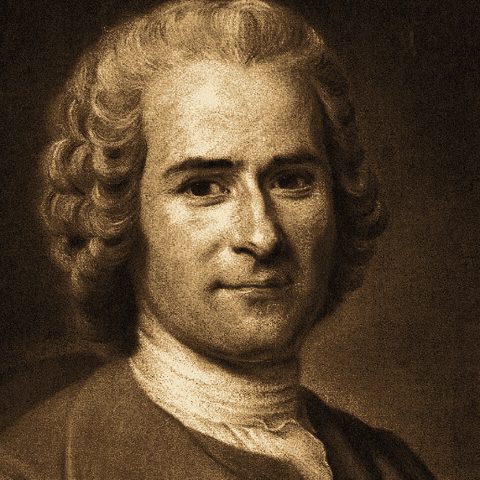
About the author
Jean-Jacques Rousseau
1712 Geneva – 1778 Ermenonville · Genevan philosopher, writer, and composer
Jean-Jacques Rousseau was a Genevan philosophe, writer, and composer. His political philosophy influenced the progress of the Age of Enlightenment throughout Europe, as well as aspects of the French Revolution and the development of modern political, economic, and educational thought.
- 1712Born, Geneva
- 1755A Discourse Upon the Origin and the Foundation of the Inequality Among Mankind
- 1761Eloisa
- 1762The Social Contract & Discourses
- 1762Emile
- 1778Died, Ermenonville
- 1782The Confessions of Jean-Jacques Rousseau
If you like The Social Contract & Discourses
More like this


Start with “Book 1, Chapter 2: The First Societies”
3 chapters free right now — no account. Your place follows you to iPhone and Android.