

3 chapters freeNo account needed.
Opens “The Prison Door” in the player · no sign-up needed
Set in the Puritan Massachusetts Bay Colony during the years 1642 to 1649, the novel tells the story of Hester Prynne, who conceives a daughter with a man to whom she is not married and then struggles to lead a new life of repentance and dignity.
Inside the book
- Free nowno account · 3 chapters
- —Part 1 of 240 min
- —Part 2 of 241 min
- 1The Prison Door3 min
- Premium23 chapters · every book, 7 days free
- 2The Market-Place19 min
- 3The Recognition17 min
- 4The Interview14 min
- 5Hester at Her Needle19 min
- 6Pearl19 min
- 7The Governor’s Hall14 min
- 8The Elf-Child and the Minister17 min
- 9The Leech19 min
- 10The Leech and His Patient19 min
- 11The Interior of A Heart14 min
- 12The Minister’s Vigil22 min
- 13Another View of Hester16 min
- 14Hester and the Physician12 min
- 15Hester and Pearl12 min
- 16A Forest Walk12 min
- 17The Pastor and His Parishioner19 min
- 18A Flood of Sunshine12 min
- 19The Child at the Brookside14 min
- 20The Minister in A Maze21 min
- 21The New England Holiday17 min
- 22The Procession20 min
- 23The Revelation of the Scarlet Letter17 min
- 24Conclusion12 min
The opening
The Prison Door
A throng of bearded men, in sad-coloured garments and grey steeple-crowned hats, intermixed with women, some wearing hoods, and others bareheaded, was assembled in front of a wooden edifice, the door of which was heavily timbered with oak, and studded with iron spikes.
The founders of a new colony, whatever Utopia of human virtue and happiness they might originally project, have invariably recognised it among their earliest practical necessities to allot a portion of the virgin soil as a cemetery, and another portion as the site of a prison. In accordance with this rule it may safely be assumed that the forefathers of Boston had built the first prison-house somewhere in the vicinity of Cornhill, almost as seasonably as they marked out the first burial-ground, on Isaac Johnson's lot, and round about his grave, which subsequently became the nucleus of all the congregated sepulchres in the old churchyard of King's Chapel. Certain it is that, some fifteen or twenty years after the settlement of the town, the wooden jail was already marked with weather-stains and other indications of age, which gave a yet darker aspect to its beetle-browed and gloomy front. The rust on the ponderous iron-work of its oaken door looked more antique than anything else in the New World. Like all that pertains to crime, it seemed never to have known a youthful era. Before this ugly edifice, and between it and the wheel-track of the street, was a grass-plot, much overgrown with burdock, pig-weed, apple-pern, and such unsightly vegetation, which evidently found something congenial in the soil that had so early borne the black flower of civilised society, a prison. But on one side of the portal, and rooted almost at the threshold, was a wild rose-bush, covered, in this month of June, with its delicate gems, which might be imagined to offer their fragrance and fragile beauty to the prisoner as he went in, and to the condemned criminal as he came forth to his doom, in token that the deep heart of Nature could pity and be kind to him.
This rose-bush, by a strange chance, has been kept alive in history; but whether it had merely survived out of the stern old wilderness, so long after the fall of the gigantic pines and oaks that originally overshadowed it, or whether, as there is fair authority for believing, it had sprung up under the footsteps of the sainted Ann Hutchinson as she entered the prison-door, we shall not take upon us to determine. Finding it so directly on the threshold of our narrative, which is now about to issue from that inauspicious portal, we could hardly do otherwise than pluck one of its flowers, and present it to the reader. It may serve, let us hope, to symbolise some sweet moral blossom that may be found along the track, or relieve the darkening close of a tale of human frailty and sorrow.
About the author
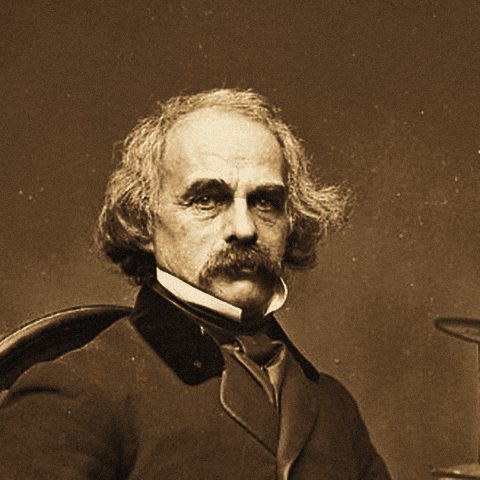
Nathaniel Hawthorne
1804 Salem – 1864 Plymouth · American author
Nathaniel Hawthorne was an American novelist and short story writer. His works often focus on history, morality, and religion.
- 1804Born, Salem
- 1850The Scarlet Letter
- 1864Died, Plymouth
If you like The Scarlet Letter
More like this


Start with “The Prison Door”
3 chapters free right now — no account. Your place follows you to iPhone and Android.